
2025 Year in Review: Dual Enrollment Legislation
Tracking State Progress Toward Expanded College in High School Opportunities
In 2025, state policymakers across the country continued to strengthen and expand college in high school programs — including dual enrollment, concurrent enrollment, and early college high school — at one of the highest rates seen in recent years. Despite tightening state budgets and federal uncertainty, legislative activity rebounded sharply from 2024, signaling strong and sustained commitment to expanding college access for high school students.
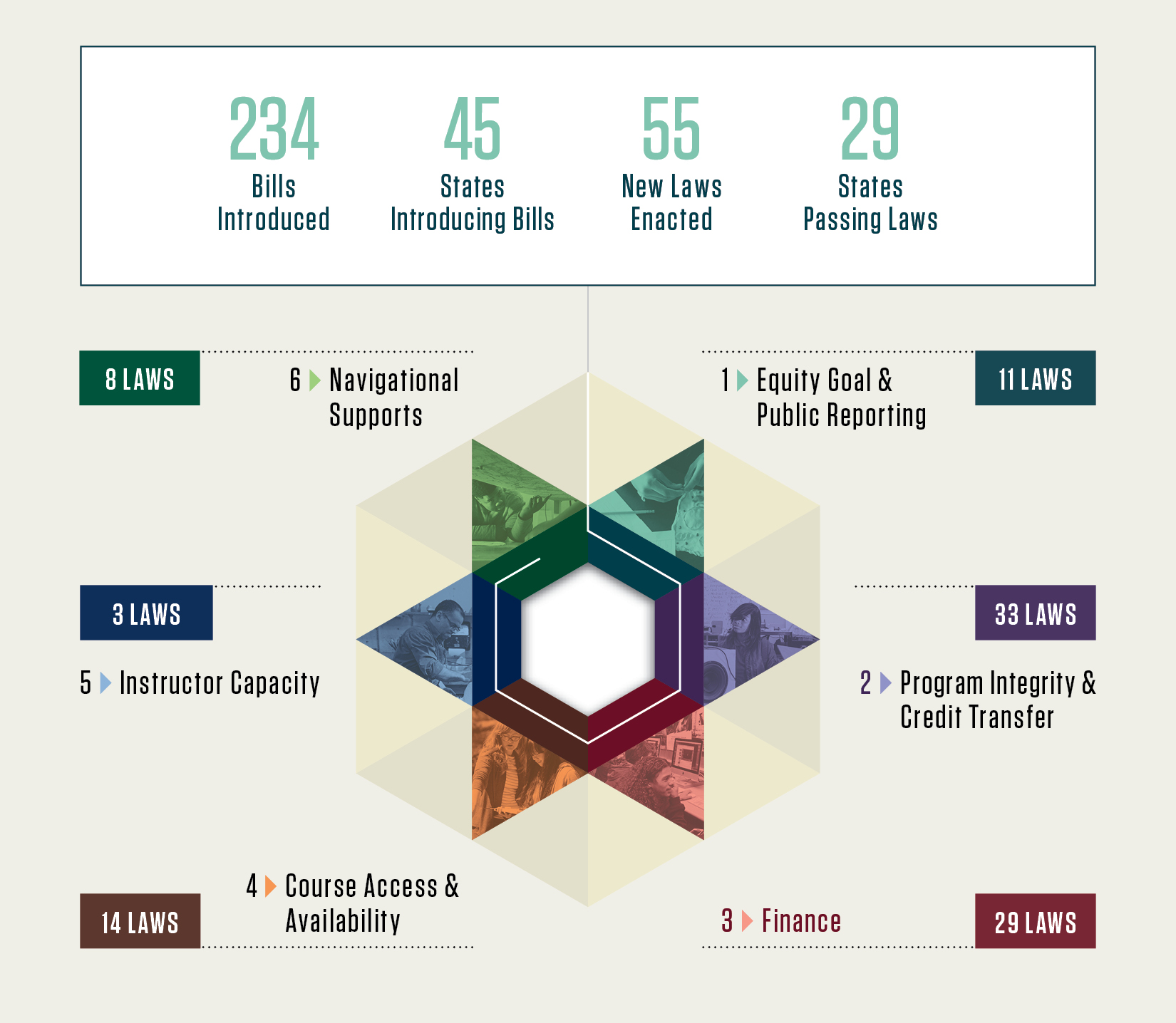
According to CHSA's 2025 Year in Review State Legislative Tracker, 234 bills were introduced across 45 states, resulting in 55 new laws enacted in 29 states — an increase from 39 new laws in 2024, and a return to the higher levels of activity seen in 2022 and 2023. Notably, 2025 also marked a historic milestone: New York became the 50th state to adopt a statewide dual enrollment policy, completing the map of state-level policy coverage nationwide.
Top Areas of Legislative Activity
Using CHSA's Unlocking Potential: A State Policy Roadmap for Equity and Quality in College in High School Programs as a framework, the 2025 legislative activity was most concentrated in:
- Program Integrity & Credit Transfer (33 laws enacted)
- Finance (29 laws enacted)
- Course Access & Availability (14 laws enacted)
- Equity Goal & Public Reporting (11 laws enacted)
- Navigational Supports (8 laws enacted)
- Instructor Capacity (3 laws enacted)
These results reflect where states are most focused: ensuring the credits students earn count, building funding structures that sustain program growth, and broadening access to the students who need it most.
Notable 2025 Laws
Several states passed standout legislation with significant implications for dual enrollment access, quality, and equity:
- Arkansas HB1512/SB246 — Overhauls concurrent enrollment financing by replacing the existing Concurrent Challenge Scholarship with the new ACCESS to Acceleration Scholarship, establishes uniform statewide tuition rules, and eliminates tuition and fee costs for participating students and families.
- Connecticut HB6445 — Strengthens statewide dual enrollment quality and consistency by requiring parent notifications for grades 8–11, directing development of a model secondary–postsecondary partnership agreement, and mandating NACEP accreditation for concurrent enrollment courses on a defined timeline.
- Illinois HB2967 — Creates a standing Dual Credit Committee to guide updates to dual credit policy, and establishes a formal appeals process when a college denies or withdraws approval of a dual credit instructor — with defined timelines and a final, binding decision by the ICCB board.
- Kentucky HB193 — Expands dual credit eligibility beyond juniors and seniors, defines the dual credit tuition ceiling as one-third of the per-credit tuition rate, and sets scholarship limits for CTE and general education dual credit coursework.
- New York S3006 — Requires adoption of a statewide dual enrollment definition and data-reporting guidelines, and obligates participating schools to submit partnership agreements with higher education partners. The accompanying state budget authorized $9.1 million for a College in High School Opportunity Fund, providing $90 per credit hour for college credit completions by low-income students.
Key Trends to Watch
The 2025 legislative landscape revealed several important patterns that will shape dual enrollment policy discussions in the years ahead.
Resolving tension between high schools and colleges. Several of the most significant laws passed in 2025 address longstanding friction points in the K–12 and higher education partnership. Illinois' new appeals process for instructor credentialing decisions is a prime example of states stepping in to adjudicate disagreements that have historically stalled program development.
Using funding to drive policy goals. States are increasingly leveraging financial incentives to steer dual enrollment programs toward specific student populations and course types. New York's College in High School Opportunity Fund targets expansion for low-income students, while adjustments to Kentucky's dual credit scholarship give the state's Council on Postsecondary Education authority to restrict scholarship eligibility to the most transferable courses.
All 50 states now have a dual enrollment policy. With New York's landmark legislation in 2025, every state in the country has some form of statewide dual enrollment policy — a significant milestone for the field. The focus now shifts from establishing policy to refining it, as states work to align their dual enrollment ecosystems with broader goals around equity, completion, and workforce readiness.
Given that state budgets are likely to remain tight in 2026, CHSA expects many of these discussions to intensify as states move through annual and biannual budget cycles. The conversation is no longer about whether to have a dual enrollment policy — it's about making that policy work harder for students.
Explore the Full Tracker
For detailed summaries of every 2025 dual enrollment bill — including enacted laws and emerging policy trends by state — download the full 2025 Year in Review report below. For summaries and more information about all of the bills introduced in 2025, visit the State Legislative and Regulatory Tracker. The database will continue tracking all new bills and regulatory actions in 2026.